Mind Your Language!
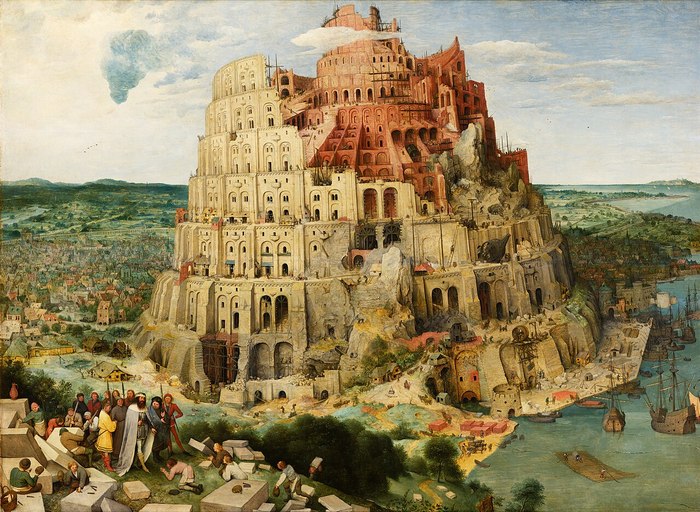
A Bible Lesson
In the story of the Tower of Babel in Genesis chapter 11 God punishes mankind for their hubris in trying to build a tower to heaven.
It is envisaged that originally mankind had only a single language and that punishment took the form of destroying the tower and then fracturing mankind's linguistic homogeneity. Multiple languages meant people couldn’t communicate easily and so cooperate.
It's easy to see why ancient people would experience multiple languages as a curse and a punishment. It would become difficult to ascertain whether another tribe was hostile or friendly and it would be very difficult to negotiate prices when you wanted to trade.
It was traditionally believed that as a result of the fall of the tower there were originally 72 languages but the reality today is that there are about 6,000 languages. I say ‘about’ as it is difficult to make a hard and fast distinction between a language and a dialect.
About 500–10,000 of these languages are spoken by only a handful of people and they are dying off at a rate of 250 a decade. Experts say that by the year 3000 just 600 languages will be left.
Let them die
What is striking is that while ancient people viewed a single language as a blessing, in the modern world many think that the death of any minority languages is a tragedy. For instance the linguist David Crystal considers the death of languages as equivalent to the loss of biodiversity in nature and thinks that we all suffer cultural loss as a result.
On the other hand the writer Kenan Malik in his article ‘Let Them Die’ (2000) considers that if a language is not fulfilling its function as a means of communication then there is no benefit in keeping it alive artificially.
Campaigners for linguistic diversity
Campaigners for linguistic diversity portray themselves as liberal defenders of minority rights, protecting the vulnerable against the nasty forces of global capitalism.
Beneath the surface rhetoric, however, their campaign has much more in common with reactionary, backward-looking visions, such as William Hague's campaign in the 1970s to 'save the pound' as a unique expression of British identity.
At the core of the preservers' argument is the belief that a particular language is linked to a particular way of life and a particular vision of the world.
But the idea that French speakers' view the world differently from English speakers, because they speak French, is clearly absurd. It is even more absurd to imagine that all French speakers have a common view of the world, thanks to a common language.
The belief that different peoples have unique ways of understanding the world became, in the nineteenth century, the basis of a racialised view of the world.
Today, biological notions of racial difference have fallen into disfavour, largely as a result of the experience of Nazism and the Holocaust. But while racial science has been discredited, racial thinking has not. It has simply been re-expressed in cultural rather than biological terms.
The contemporary argument for the preservation of linguistic diversity, liberally framed though it may be, draws on the same philosophy that gave rise to ideas of racial difference.
Enoch Powell wrote "Every society, every nation is unique. It has its own past, its own story, its own memories, its own ways, its own languages or ways of speaking, its own---dare I use the word---culture."
Language preservers may be acting on the best of intentions, but they are treading on dangerous ground, and they carry with them some unpalatable fellow-travellers.
The linguistic campaigners have a thoroughly confused notion of rights. When they say the right of people to exist, to practice and produce their own language and culture, should be inalienable, they are conflating two kinds of rights---individual rights and group rights.
An individual certainly has the right to speak whatever language he or she wants, and to engage in whatever cultural practices they wish to in private. But it is not incumbent on anyone to listen to them, nor to provide resources for the preservation of either their language or their culture.
The reason that a langauge goes extinct is not because someone has been denied her rights, but because no one else wants to, or is capable of, speaking the language.
This may be sad for the speakers and frustrating for professional linguists vbut it is not a question of rights. Neither a culture, nor a way of life, nor yet a language, has a God-given 'right to exist'.
Language campaigners also confuse political oppression and the loss of cultural identity.
Groups---such as Turkish Kurds---are banned from using their language as part of a wider campaign by the Turkish state to deny Kurds their rights. But most languages die out, not because they are suppressed, but because native speakers yearn for a better life.
Speaking a language such as English, French or Spanish is often a ticket to modernity. But it is modernity itself of which the campaigners disapprove. They want the peoples of the Third World, and minority groups in the West, to follow 'local ways of life' and pursue 'traditional knowledge' rather than receive a 'Western education'.
There is nothing noble or authentic about local ways of life; they are often simply degrading and backbreaking and people yearn for the benefits of modernity.
Britain's minority languages
While it’s true that in the past suppressing a community’s language has been a powerful means of social and political control should governments today be financing programmes for supporting a secondary language that only a small minority are using.
In the British Isles and Ireland we have seven indigenous languages but not a lot of speakers:
| Language | Approx. number able to speak |
|---|---|
| 1. Irish (Gaeilge) | about 2.1 million |
| 2. Welsh (Cymraeg) | about 540,000 in Wales |
| 3. Manx (Gaelg) | about 2,200 |
| 4. Cornish (Kernewek) | about 500-600 |
| 5. Scottish Gaelic (Gàidhlig) | about 70,000 |
| 6. Scots | about 1.5 million |
| 7. Ulster Scots | about 190,000 |
Irish
The 2022 Republic of Ireland census found 1,873,997 people aged three and over who said they could speak Irish.
That includes very large numbers who acquired it through schooling (it's compulsory in southern Ireland) but seldom or never use it.
Only 71,968 people said they spoke it daily outside the education system, with another 115,065 speaking it weekly.
Northern Ireland adds another 228,600 people with some ability in Irish. Of these, about 71,900 reported that they could speak, read, write and understand it. Only about 6,000 people in Northern Ireland reported Irish as their main language.
So we need to distinguish between roughly 2.1 million people who claim some ability in Irish and perhaps 150,000--200,000 who use it with reasonable regularity and therefore comprising a living language community.
Welsh
Welsh has about 538,300 speakers according to the 2021 Census, representing 17.8% of the population of Wales aged three and over. The Welsh Government's Annual Population Survey gives a considerably higher estimate---around 900,600 for 2022---because it uses a different methodology.
Scots
Scots is another interesting case. The 2022 Scottish Census found that 46.2% of people aged three and over had some Scots language skills. The corresponding figure for people who could actually speak Scots in the previous census was about 1.5 million.
This makes Scots potentially the second-largest indigenous language of the British Isles after Irish, depending on what we mean by 'language'. Its status is somewhat controversial because there is a continuum between Scots and English, and people differ considerably in how they classify their own speech.
Scottish Gaelic
Scottish Gaelic is much smaller. The 2022 Scottish Census found that 2.5% of the population aged three and over had some Gaelic skills, approximately 135,900 people. But only about 70,000 could actually speak it.
Ulster Scots
Ulster Scots is comparable in size to Gaelic if we use the broader "some ability" criterion: 190,600 people in Northern Ireland reported some ability in 2021. However, only about 20,900 said they could speak, read, write and understand it.
Questions
Shouldn’t we just treat these languages as private hobbies for those who are interested? Should the BBC be spending money on Welsh programming for only half a million citizens? We publicly fund the arts like opera for a minority, so it's argued why not fund minority languages? But the difference here is that while not everyone might enjoy opera they at least have open access to it. Only those who speak the minority language get ant benefit from it.
Foreign languages in the UK
In contrast to many European countries the UK is 85%–90% monoglot. In the Netherlands over 90% speak at least one foreign language. In Sweden it’s around 85–90%, and in Germany it’s around 60–70%.
Is this grounds for national shame?
Language teaching in the UK is now on the national curriculum but schools report problems in specialist teacher recruitment and university courses have reduced.
But does this matter? After all English has become the de facto international language. It is used in shipping, air transport, technical documentation and so many other areas of life. So why should we Brits be bothered about speaking their language when they can all speak ours?
Or are there other reasons for learning another language? Does it change your view of the world? Does your personality change when you are immersed in another language?
Bilingualism
● Tynged yr Iaith (The Fate of the Language, 1962)
● Provision of Bilingual Services in Wales
● What is the cost of bilingualism in Wales?
English
● How many English people speak a second language?
● Controlled/Restricted Forms of English
● Watch your language: AC Grayling vs Jean Aitchison
Foreign Language Teaching
● Modern foreign languages are not in crisis. It’s worse than that
● The current state of foreign language teaching in England
● The current state of foreign language teaching in England
● The Death of Modern Foreign Languages
● The Strange Persistence of First Languages
International Auxiliary Languages
● Thoughts on International Auxiliary Language Success
● Design of an International Auxiliary Language
● Farewell to Auxiliary Languages
Minority Languages
● The Story of the Tower of Babel (Gen 11:1--9)
● Are Dying Languages Worth Saving?
● Assessing the Value of Dying Languages
● Scientists Fret as One Language Disappears Every Fourteen Days
● Revitalising Native American Languages
● Foundation for Endangered Languages
● How to Save a Dying Language
● Six Last Living Speakers of Dying Languages
● Smithsonian Archives Preserve Lost and Dying Languages
● Ten Languages on the Verge of Extinction